Hadoop#
An item of a VFS of the type HADOOP points at a folder of a Hadoop file system, HDFS. The server speaks WebHDFS, HDFS's interface over HTTP. The same item works with HttpFS and through an Apache Knox gateway.
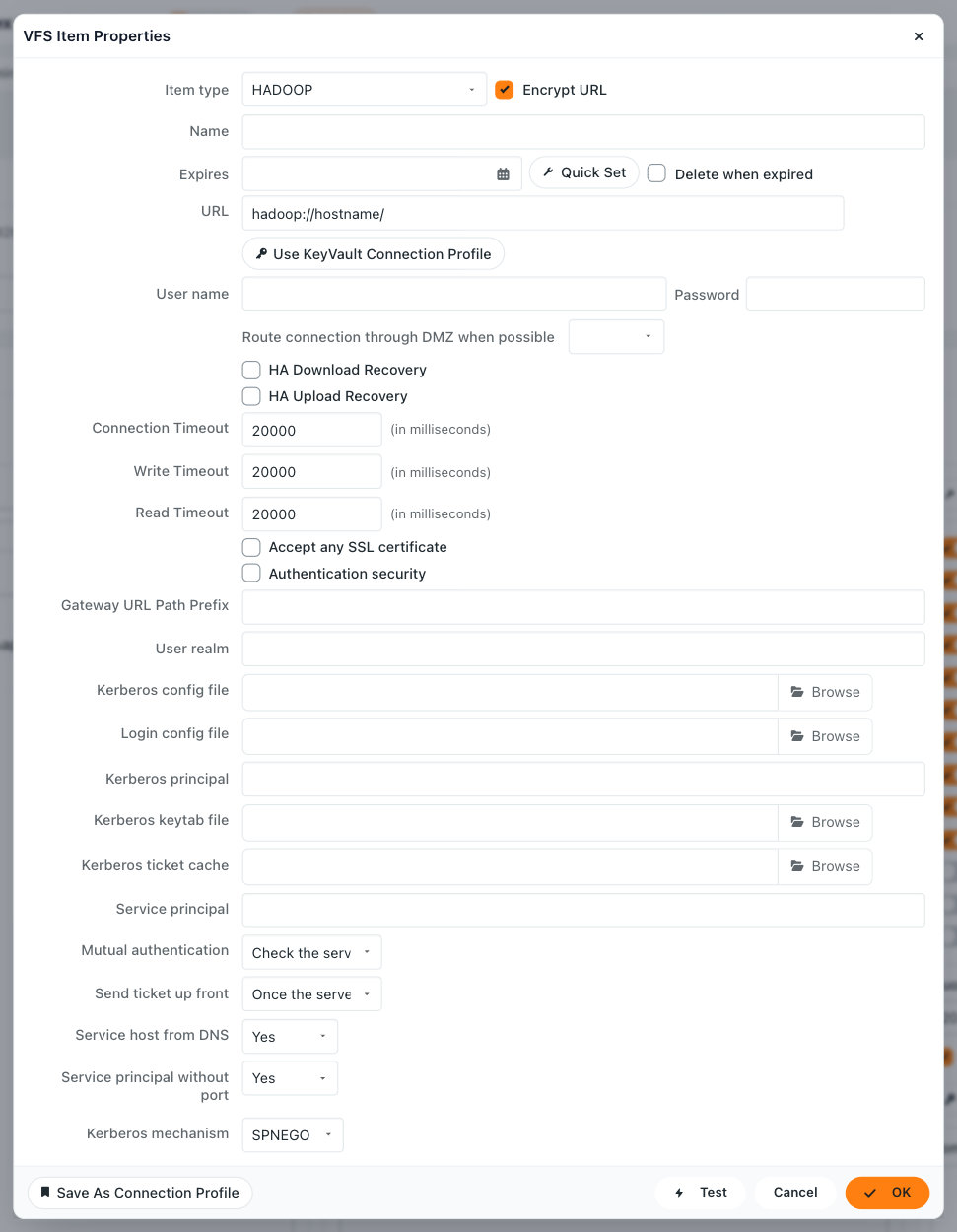
The address#
hadoop://namenode.example.com:9870/data/incoming/ : the host and port at which WebHDFS answers, and a folder of HDFS.
| You connect to | Host and port | Gateway URL Path Prefix |
|---|---|---|
| the NameNode's WebHDFS | the NameNode, usually port 9870, or 9871 with TLS | empty |
| HttpFS | the HttpFS server, usually port 14000 | empty |
| Knox | the gateway, usually port 8443 | the path of the topology, such as /gateway/default |
With WebHDFS directly, the NameNode sends the server on to the DataNodes for the content of files: the server machine must be able to reach every DataNode by the name the cluster uses. HttpFS and Knox pass everything through one address, which is the usual choice for a server outside the cluster.
Logging in#
| Field | What it is |
|---|---|
| User name | the HDFS user the server acts as |
| Password | for Knox and other gateways that ask for a name and a password |
| Authentication security | on: the cluster is secured with Kerberos. The fields below then count. |
Kerberos#
| Field | What it is |
|---|---|
| Kerberos principal | who the server is, such as crushftp@EXAMPLE.COM |
| Kerberos keytab file | the keytab of that principal, a file on the server machine |
| Kerberos ticket cache | instead of a keytab: a ticket cache that another program keeps fresh |
| Kerberos config file | the krb5.conf to use, when it is not the machine's own |
| Login config file | a JAAS login file, for set-ups that need one |
| User realm | the realm of the user |
| Service principal | the principal of the web service. Empty: HTTP/ and the host of the address. |
| Mutual authentication | Check the server's token when sent, Require the server's token, or Off: whether the cluster must prove itself to the server too |
| Send ticket up front | Once the server has asked, Always, or Never: when the ticket is put into a request |
| Service host from DNS | Yes: the service's name is the canonical name DNS gives for the host. No: the name as written in the address. |
| Service principal without port | Yes: the port is left out of the service's name, as most clusters want |
| Kerberos mechanism | SPNEGO, the usual, or plain Kerberos |
The first three are what most clusters need; leave the others as they are until a login fails. The clocks of the server machine and the cluster must agree to within a few minutes.
TLS#
With a port that speaks TLS, the cluster's certificate must be trusted by the server: see SSL. Accept any SSL certificate turns the check off, for tests only.
The options every type has are on Advanced options of a VFS item.
When it does not work#
The server says so when something else than WebHDFS answers: "the server answered … but not with a WebHDFS listing … Something other than WebHDFS answered; check the URL".
| What you see | Usually |
|---|---|
| that message | the port, or a missing Gateway URL Path Prefix |
| listings work, files cannot be read or written | the DataNodes cannot be reached from the server machine: use HttpFS or Knox |
| "401" with Kerberos | principal or keytab; clocks; the service principal: try Service host from DNS the other way |
| "permission denied" | the HDFS user has no rights on the folder |