The database table scripts#
Before the server can keep users in a database, the database needs the tables. The Scripts tab of the User Config section of Preferences has the script that makes them, once for MySQL and once for Microsoft SQL Server.
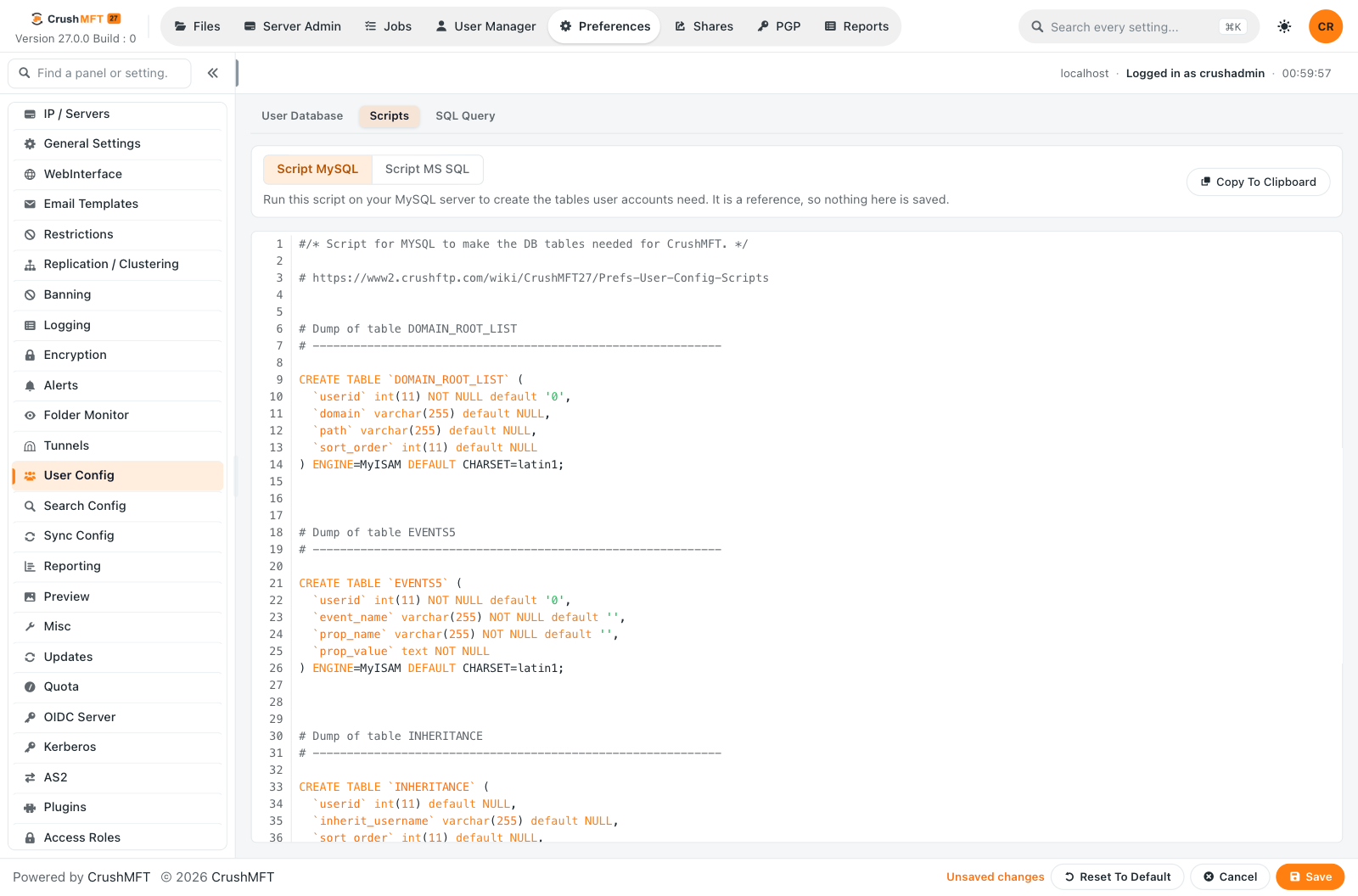
| Control | What it does |
|---|---|
| Script MySQL, Script MS SQL | shows the script for that database |
| Copy To Clipboard | copies the whole script that is shown |
The tab is for reading and copying. Nothing on it is saved, and it does not run the script: do that with the tool of your database, logged in to the database the server will use.
Running it#
- Make an empty database, such as
crushftp, and an account for the server that may read and write in it. - Copy the script and run it in that database.
- Go on with Moving to a database.
The script only makes tables. It puts no users in: those come with Import From XML.
The tables#
| Table | Holds | Columns |
|---|---|---|
USERS |
one row per user | userid, a number the database gives; username; password, in its stored form; server_group, the user connection group |
USER_PROPERTIES |
every setting of a user, one row each | userid, prop_name, prop_value |
INHERITANCE |
whom a user inherits from | userid, inherit_username, sort_order, server_group |
GROUPS |
the members of each group | groupname, userid, server_group |
VFS |
the items of a user's virtual file system | userid, url, type, path, sort_order |
VFS_PERMISSIONS |
the permissions on them | userid, path, privs |
VFS_PROPERTIES |
further settings of them | userid, path, prop_name, prop_value |
EVENTS5 |
a user's events, one row per setting of an event | userid, event_name, prop_name, prop_value |
IP_RESTRICTIONS |
a user's allowed and refused addresses | userid, start_ip, type, stop_ip, sort_order |
DOMAIN_ROOT_LIST |
a user's start folder per host name | userid, domain, path, sort_order |
WEB_BUTTONS |
a user's buttons in the web interface | userid, sql_field_key, sql_field_value, for_menu, for_context_menu, sort_order |
WEB_CUSTOMIZATIONS |
a user's settings of the web interface | userid, sql_field_key, sql_field_value, sort_order |
MODIFIED_TIMES |
the mark by which several servers know that something changed | server_group, prop_name, prop_value |
Everything hangs on userid: a user is the row in USERS plus all rows with that number in the other tables.
The script for MySQL#
It also runs on MariaDB. Three things in it are worth a look before you run it:
- The character set is
latin1. Letters outside the Western European ones in user names, paths and settings are not kept as they are. If you have such names, changelatin1toutf8mb4everywhere in the script first. - The engine is
MyISAM. Change it toInnoDBif that is what your database is run with. prop_valueofUSER_PROPERTIESholds 2,000 characters, andurlandpathofVFShold 255. If your users have longer values, make these columns larger in the script.
GROUPS is a reserved word since MySQL 8. The script writes the name in backticks, and the server does the same in its statements for MySQL and MariaDB by itself.
The script for Microsoft SQL Server#
Its text columns are varchar(MAX), so lengths are not a matter there, and userid of USERS is an identity column.
Another database#
The server talks to the database through JDBC with plain statements, all of which you can see and change on the User Database tab. For a database the tab has no script for, make the same thirteen tables with the same column names in the types of that database, with userid of USERS as a number the database counts up by itself.