AS2 overview#
AS2 is the way companies send each other business documents over the internet: orders, invoices, shipping notices. Retailers, logistics firms and banks often insist on it. A file sent by AS2 is signed, so the receiver knows who sent it; encrypted, so only the receiver can read it; and answered with a signed receipt, so the sender can prove it arrived unchanged.
The server does both sides: it receives AS2 messages from your partners, and it sends files to them.
The parts of an AS2 exchange#
| Part | Is |
|---|---|
| AS2 names | each side has an identifier, agreed between you, such as ACME and EXAMPLECO. They travel in every message as AS2-From and AS2-To. |
| certificates | each side has a key pair and gives the other its certificate. Yours decrypts what partners send you and signs what you send; theirs does the same for them. See AS2 certificates. |
| addresses | each side has a web address where it takes messages |
| the message | the file, signed and encrypted, posted to the partner's address over HTTPS |
| the receipt (MDN) | the partner's signed answer: "received, and this is its checksum". See Receipts. |
The pages#
| To | See |
|---|---|
| set up a partner | Trading partners |
| make and exchange certificates | AS2 certificates |
| receive files | Receiving |
| send files | Sending, and the AS2 task |
| understand and keep receipts | Receipts (MDN) |
| move to the new engine | Moving from AS2 version 1 |
Two engines#
Version 27 has two AS2 engines, side by side. They share nothing; a partner is on one or the other, and both can run on the same server at once.
| Version 1 | Version 2 | |
|---|---|---|
| what it is | the AS2 that every earlier version had | a new engine, written for version 27 |
| on a new server | on | off, until you turn it on |
| set up | in the admin pages: partners are users of the User Manager, sending is the AS2 task | by settings and admin commands. It has no pages of its own yet. |
| a partner is | a user. The partner signs in with that user's name and password, carried in the AS2 name. | a partner entry, known by its certificate. No login takes place. |
| a file is | held in memory while it is worked on. Large files need a large heap; around 1 GB is the end. | streamed. Files of many gigabytes are fine. |
| checks | the signature is checked when the user has a verification key | signature required unless you say otherwise; the checksum, the time, repeats and the size are checked for every message |
| a message that arrives twice | is stored twice | is recognised, and answered with the first receipt |
| AS2 versions | 1.1 | 1.1, 1.2, 1.3: compression, several files in one message, newer algorithms |
| in FIPS mode | off | the engine to use |
Which to use#
- A server that was upgraded and has working partners: they are on version 1 and go on working, unchanged. Nothing has to be done.
- A new partnership on a server run through the admin pages: version 1. Everything is on screens, and these pages describe it first.
- Large files, a partner that asks for AS2 1.2 or modern algorithms, FIPS mode, or a wish to end passwords in AS2 names: version 2. Be ready to work with settings and commands: see Moving from AS2 version 1, which also describes how version 2 is set up.
A server tells its administrators when it still has version 1 partners that could move: a line at start, a line in the log of each AS2 task run, and at most one alert a day. It is advice. Version 1 has no end date.
The AS2 section of Preferences#
Preferences › AS2 holds the settings of AS2 version 2, its stations and partners, its messages, and the settings of version 1. Each tab is one part.
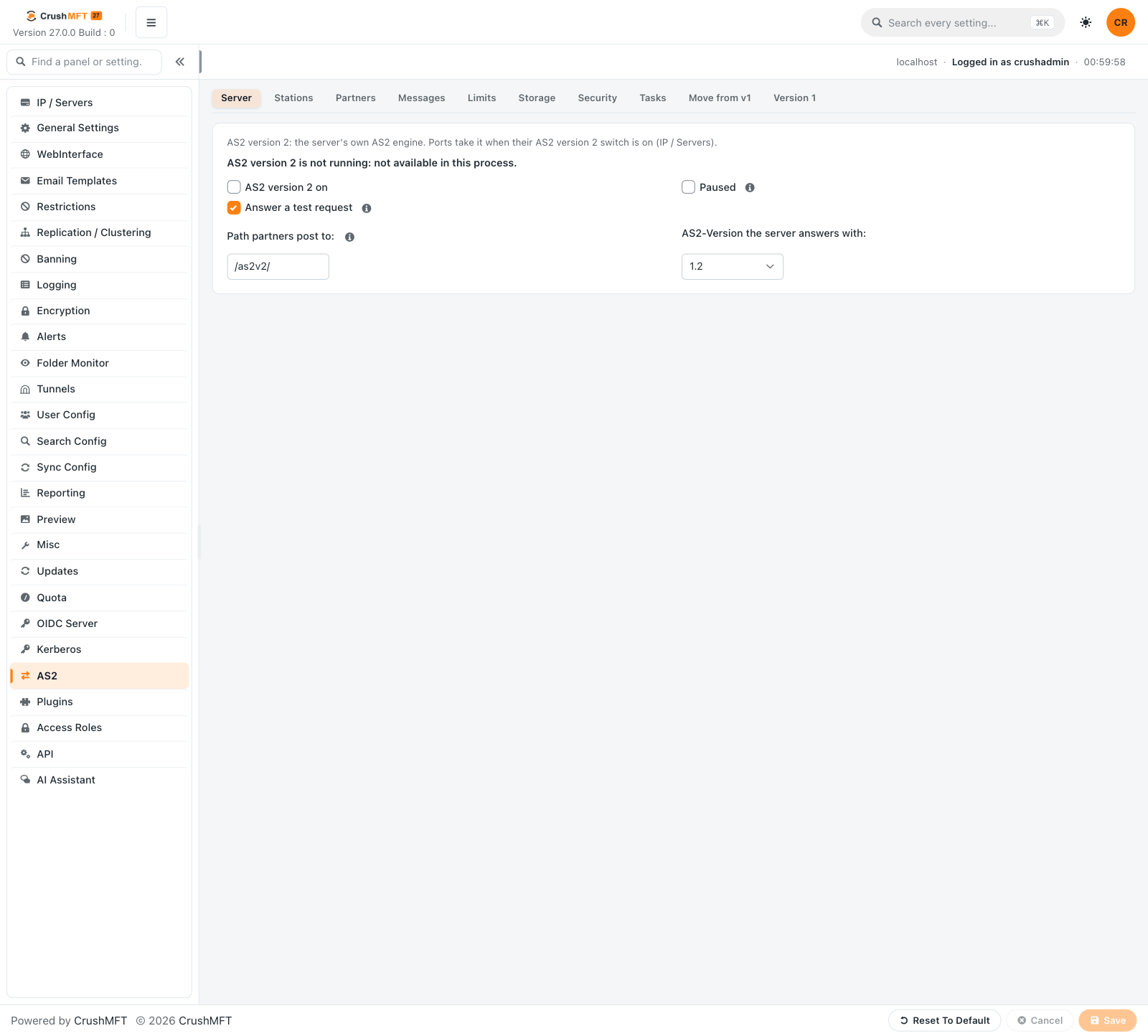
| Tab | Holds |
|---|---|
| Server | version 2 on or off, paused, the path partners post to, the AS2-Version the server answers with, and whether a test request is answered |
| Stations, Partners | your own AS2 identities and the partners, each with its keys and rules. Check tests an entry before it is saved. |
| Messages | the messages received and sent, with what happened to each |
| Limits | the largest message, how much a sender may send before it is known, how many messages are received at the same time |
| Storage | where the records and the message files are kept, how long, and how long a delivery to its user is retried |
| Security | how many failed checks from one address block it, for how long, and which DMZ or proxy addresses are believed for the client's address |
| Tasks | the weakest algorithms and the AS2-Version an AS2 task of a job may use |
| Move from v1 | the steps of bringing version 1 partners over: Upgrade from version 1 |
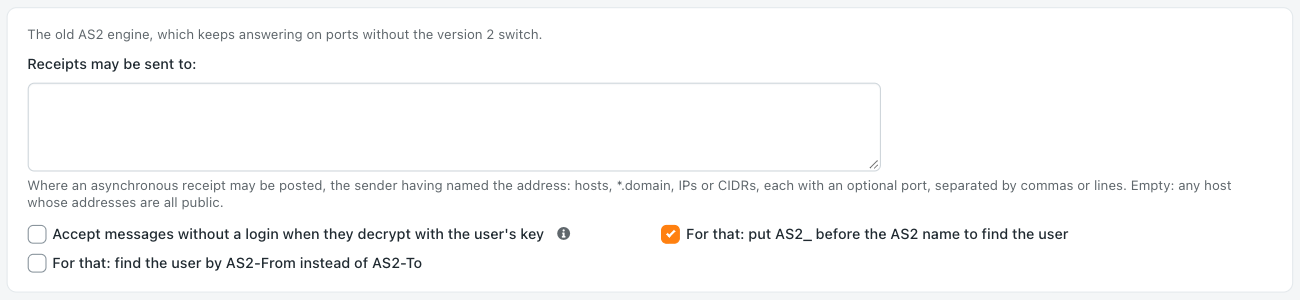
| Version 1 | where receipts of the old engine may be sent, and its login without a password |

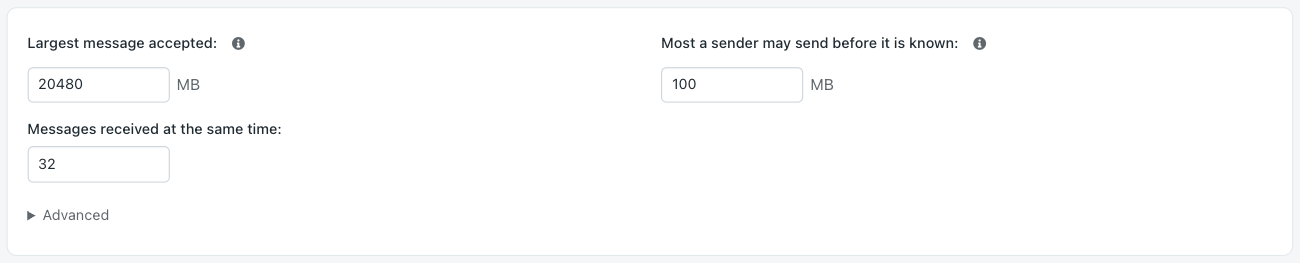
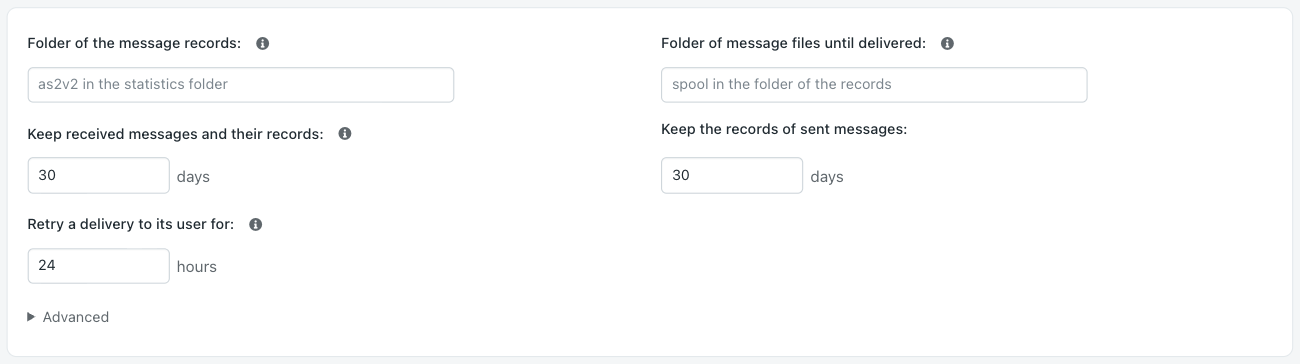
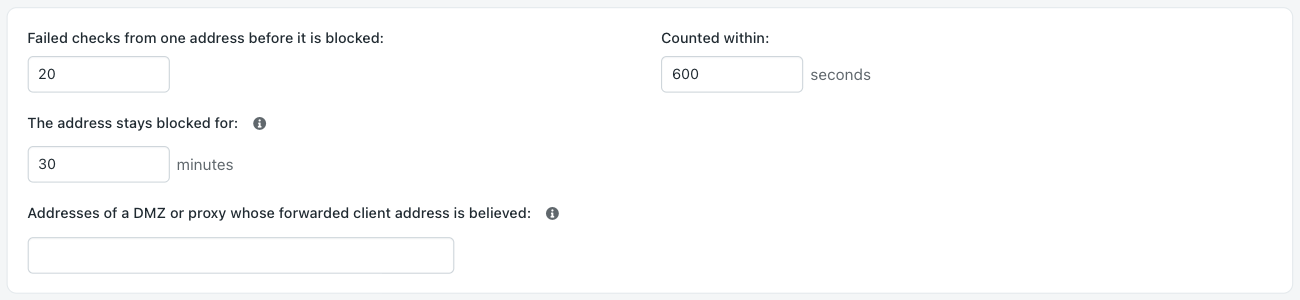
Each field's key is in Every preference key, with the tab and the field's name: the keys of version 2 start with as2v2_, those of version 1 with as2_.
What you need before you start#
From the partner, and they from you:
- the AS2 name
- the address to post to
- the certificate
- the algorithms for signing and encrypting: today SHA-256 and AES-256
- whether receipts come at once or later, and whether they are signed
Write these down in one place per partner. Most AS2 trouble is one of the five not matching.
And on your side:
- a secure web port that partners can reach from the internet: the ports of the server, with a certificate their systems trust: SSL certificates
- a key pair for AS2: AS2 certificates
- for sending: an Enterprise licence, as in earlier versions. Receiving works with every licence.
Things to know#
- The AS2 certificate is not the HTTPS certificate. They can be the same file, but they do different jobs: one protects the connection, the other signs and encrypts the document. Most set-ups use a certificate you made yourself for AS2, and a bought one for HTTPS.
- AS2 is one file per message, pushed. Nobody fetches. If the partner's server is down, the send fails and must be tried again: a job does that.
- Test with the partner before going live. Every AS2 product reads the standard a little differently. Send one file each way, with receipts, and compare the five points above when it fails.
- AS3, the same idea over FTP, is taken only as a receiver, by version 1: Process AS3 Files in a user's settings. AS4 is not offered.
Not tried for these pages#
No AS2 message was sent or received for these pages. Version 1 is described from the admin pages, the earlier documentation, and the design papers of the new engine, which record how version 1 behaves. Version 2 is described from its design and build record and from the answers of its admin commands on a test server, where it was off.