SFTP and SCP ports#
A listener of the protocol SFTP/SCP (SFTP://) answers SSH clients for file transfer: SFTP, and the older SCP. It is made in IP / Servers. The usual port is 22; a new server listens on 2222, so that it does not collide with the machine's own SSH service.
The listener offers file transfer only. Nobody gets a command line on the server through it.
An SFTP listener has a tab of its own, SSH:
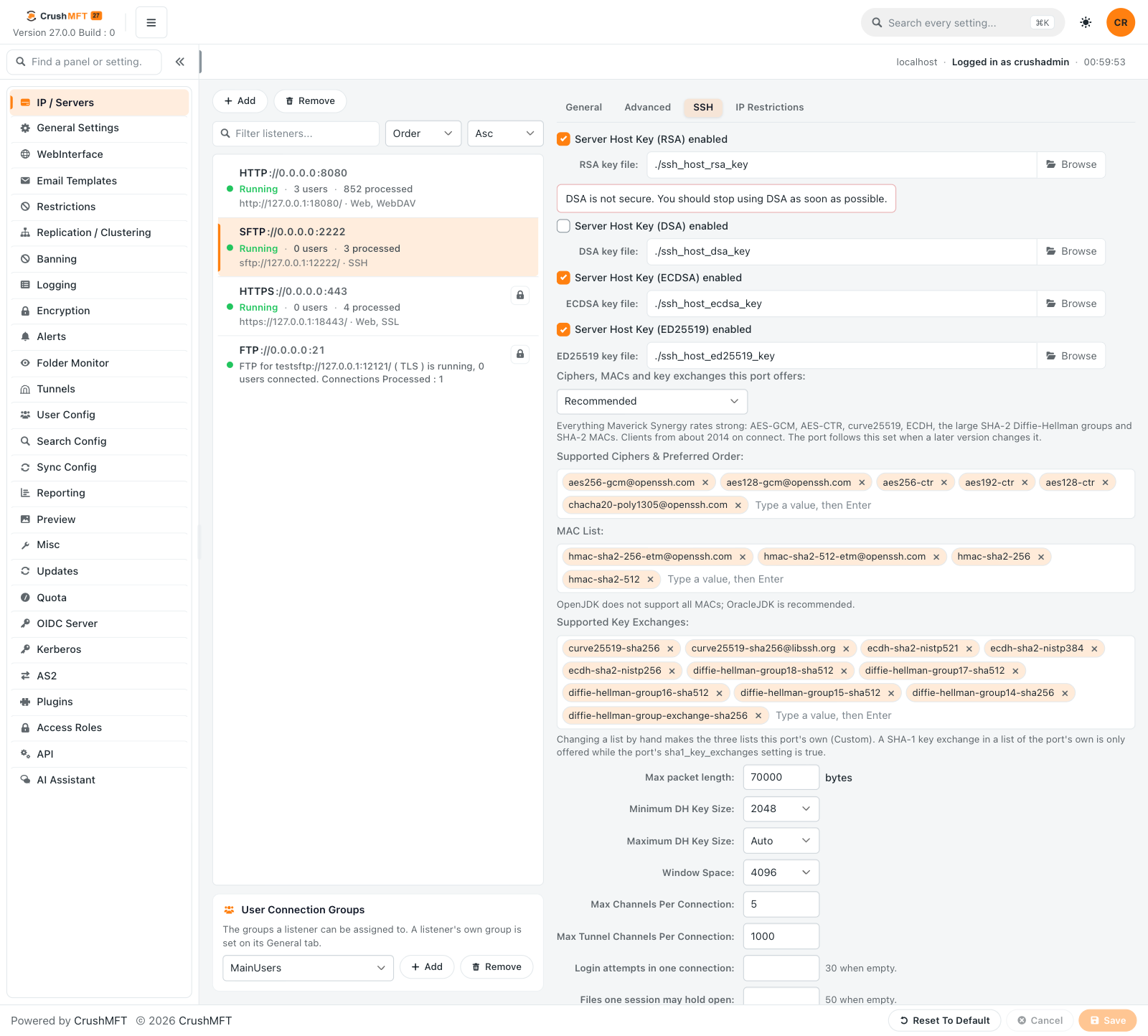
Host keys#
The key by which the server proves to clients that it is itself. See SSH host keys, ciphers and key exchange.
Ciphers, MACs and key exchanges#
Which algorithms the port offers, as one of four ready sets or as lists of your own: the same page.
Logging in#
| Setting | What it does | New listener |
|---|---|---|
| Require Password Authentication | every login on this port needs the password, also one that has shown a key | off |
| Require Public Key Authentication | every login on this port needs a key, also one that has given the password | off |
| Auth timeout | how long a client may take to log in, in seconds | 30 |
With neither required, a user gets in with a key that is listed for them, or with the password. With both, every login needs both. The same can be demanded for single users instead of the whole port: see SSH public keys of a user.
Sessions#
| Setting | What it does | New listener |
|---|---|---|
| Idle Timeout | a session that does nothing for this long is closed, in seconds | 300 |
| Keep-alive interval | how often the server sends a keep-alive, so that firewalls do not drop a quiet connection, in seconds | 30 |
| Max Channels Per Connection | how many channels one connection may open. A client that opens files in parallel uses one each. | 5 |
| Max Tunnel Channels Per Connection | the same for port forwarding through SSH | 1000 |
| Text Encoding | how file names are read and written | UTF8 |
| Allow SSH compression | clients may ask for compression | on |
| SFTP Welcome Message, on the General tab | text shown to a client after it connects | empty |
Performance and compatibility#
Leave these as they are unless a client has trouble or the port is very busy.
| Setting | What it does | New listener |
|---|---|---|
| Max packet length | the largest packet accepted, in bytes | 70000 |
| Window Space | how much a client may send before the server answers | 4096 |
| Minimum DH Key Size, Maximum DH Key Size | the size of the group in a Diffie-Hellman group exchange. 2048 as the minimum keeps out weak groups. | 2048, Auto |
| RSA Sha1 Signatures Supported | accepts the old ssh-rsa signature with SHA-1. Only for clients that know no other. |
off |
| Use Asynchronous Threading, Max async requests | answers a client's requests on several threads at once | off, 200 |
| Transfer Threads, Accept Threads, Connect Threads | how many threads serve transfers, new connections and logins | 2 each |
| Enable debug logging | writes the SSH conversation to the log, to find out why a client cannot connect. Turn it off again. | off |
The other tabs#
Advanced has the switches every listener has, among them the PROXY protocol: see IP / Servers. IP Restrictions: see IP restrictions of a port.
Protection against misuse#
The port holds every client to one key exchange request at a time, refuses oversized requests before login, and counts channels against the limits above. A client that hammers the port is banned by the server's rules in Banning.
When a client cannot connect#
| The client says | Usually |
|---|---|
| "no matching key exchange", "no matching cipher", "no matching MAC" | an old client and a strict set: see the sets |
| "no matching host key type" | a client that knows only ssh-rsa with SHA-1: RSA Sha1 Signatures Supported, or better a newer client |
| "host key has changed" | the server's key file was replaced: see host keys |
| "permission denied" | name, password or key; a user who may not use SFTP: Protocols a user may use |
| it connects, and stalls on big listings | Use Asynchronous Threading off, Max packet length |
Enable debug logging and the user's session log in Connected users show what was offered and refused.
For the client's side, see Connecting with SFTP clients.