Template: HTTPS for CrushMFT WebInterface#
This template puts the CrushMFT WebInterface of several servers behind one HTTPS address. It makes one https listener that ends TLS at the balancer, keeps each user on the server that holds their session (the CrushAuth cookie), and tells CrushMFT the client's real address with a PROXY header.
Listeners › Add listener › HTTPS for CrushMFT WebInterface:
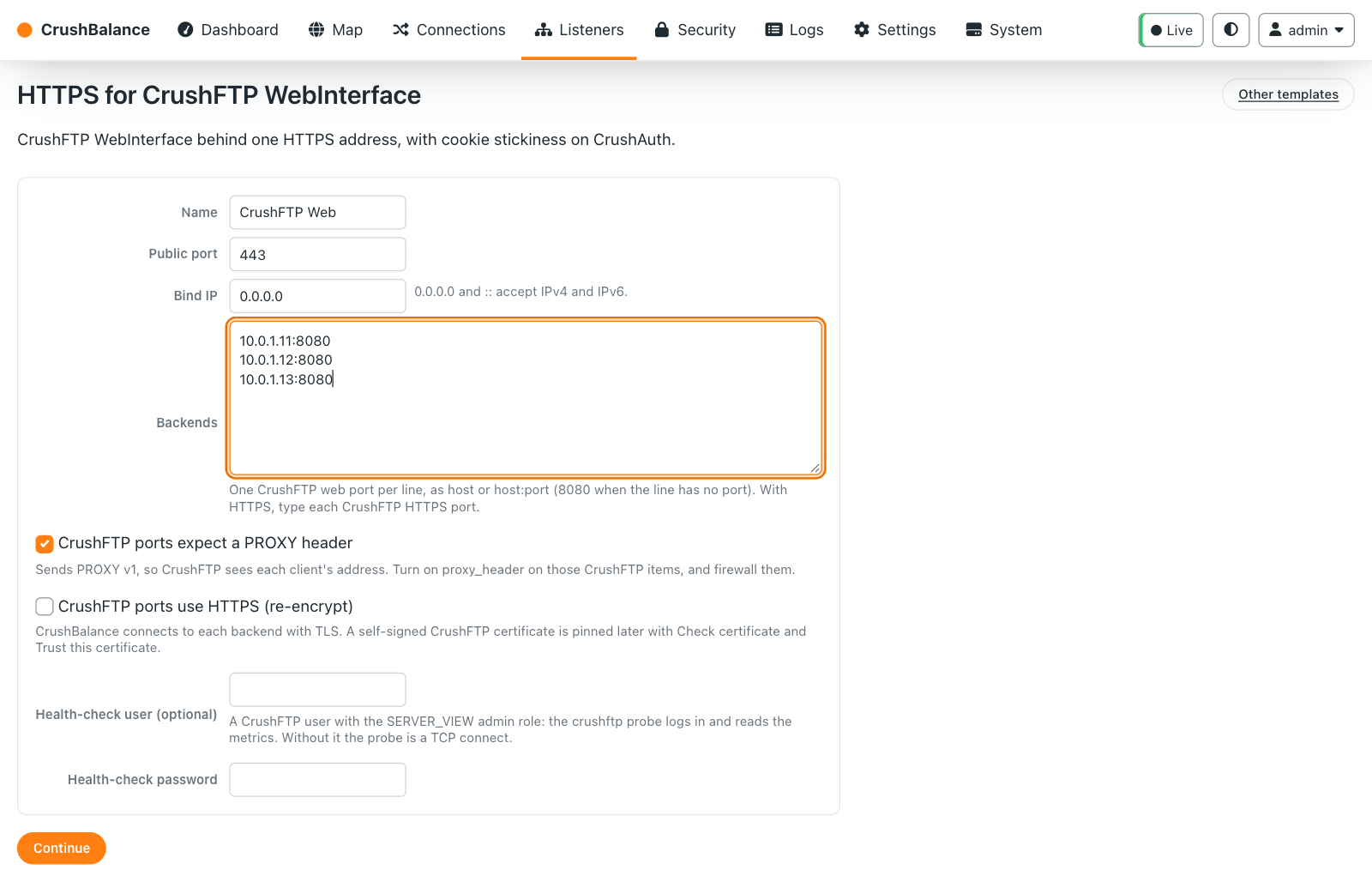
| Field | What to enter |
|---|---|
| Name | a name for the listener |
| Public port | the port clients use, 443 |
| Bind IP | 0.0.0.0 for every interface |
| Backends | one CrushMFT web port per line, as host or host:port (8080 when a line has no port) |
| CrushMFT ports expect a PROXY header | on: CrushMFT then sees each client's address. Turn proxy_header on for those CrushMFT ports. |
| CrushMFT ports use HTTPS (re-encrypt) | on when the network between the balancer and CrushMFT is not trusted; type each CrushMFT HTTPS port |
| Health-check user and password | optional: a CrushMFT user with the SERVER_VIEW admin role. With it the health check logs in and reads the server's load. |
Continue shows the listener it made in the listener editor, not saved yet. Change what you like, then Save.
The details#
Balancer side (what the template sets, or what you set):
- Mode
https, public port 443 by default. TLS uses a generated, self-signed certificate until you set a keystore on the listener's TLS tab (tls_keystore, JKS, PKCS12 or JCEKS; one password for the keystore and its key). sticky=cookiewith the cookieCrushAuth(sticky_cookies).sticky_ttl(default 1800 s) at least as long as CrushMFT's web session idle time; otherwise users who pause for longer are routed by client address or by the algorithm.- PROXY v1 on each endpoint (the template's "CrushMFT ports expect a PROXY header" option, checked by default).
- One endpoint per CrushMFT server, port 8080 by default (one
host[:port]per line). - Optional health-check user: with a user (and its password) the template sets
probe=crushftpwithprobe_url=http://<host>:<port>/, so health checks log in and read CrushMFT's metrics. The CrushMFT user needs the SERVER_VIEW (or SERVER_EDIT) admin role, and the backend must be Enterprise-licensed. Without a user the endpoints use the defaulttcpcheck (a connect).
CrushMFT side, on every backend:
- One plain HTTP item per backend that the balancer connects to, with
proxy_header(PROXY v1) on. https_redirectoff on the items behind the balancer (otherwise the browser loops), and HTTP/3 off on them.- Port 80 to 443 redirects: point a separate
http(ortcp) listener on port 80 at a separate CrushMFT HTTP item that hashttps_redirecton. - Recommended: CrushMFT Enterprise session replication (
http_token_replication_lookup_allowed), so users keep their session when a backend goes DOWN. Pins already survive balancer restarts (sticky-pins.dat, Operating). - Use the same PROXY setting on every endpoint of the listener: CrushMFT binds a web session to the client address it sees, so mixing endpoints with and without PROXY breaks sessions after a switch.
- The balancer adds
X-Forwarded-For,-Proto,-Host,-PortandX-Real-IPand removes those a client sent (unless the client is intrusted_proxies). It adds; SecuretoSet-Cookieonhttpslisteners. With PROXY on, CrushMFT'sallow_x_forwarded_hostis not needed.
Optional re-encryption to CrushMFT (backend_tls). For networks between the balancer and CrushMFT that you do not trust. The template option "CrushMFT ports use HTTPS (re-encrypt)" sets backend_tls=true on the generated endpoints and, with a health-check user, an https://<host>:<port>/ probe URL on each endpoint's own host and port. The backend port still defaults to 8080, so type each CrushMFT HTTPS port.
- In CrushMFT use one HTTPS item per backend instead of the plain HTTP item, still with
proxy_header: the PROXY header goes before the TLS handshake, which is what CrushMFT expects. Keep SNI off on those items. - The CrushMFT certificate must be trusted in one of two ways:
- a certificate the Java trust store accepts for the endpoint's host name (a CA-issued certificate for the name in
host); or - a pin. For CrushMFT's self-signed certificate: save the listener, open each endpoint, click Check certificate, compare the SHA-256 fingerprint with the certificate on the CrushMFT server, then Trust this certificate and save. This stores the fingerprint in
backend_tls_pin; the chain, dates and host name are then not checked.
- a certificate the Java trust store accepts for the endpoint's host name (a CA-issued certificate for the name in
- Until a certificate is trusted, the endpoint's health check is DOWN with "certificate not trusted (SHA-256 …)", and connections to it fail over.
- When CrushMFT's certificate changes, a pinned endpoint fails the same way: run Check certificate and Trust this certificate again. Until then the endpoint is DOWN.
- The cost: a second TLS session per connection (more CPU and memory per session, and one backend handshake per new back connection, resumed after the first).
backend_tlsapplies only ontls,httpandhttpslisteners. Atcplistener relays the client's bytes unchanged, so the client's TLS already reaches CrushMFT end to end.